By Jimy Haddad | Physiotherapist at KINETIKA Physiotherapy Dubai
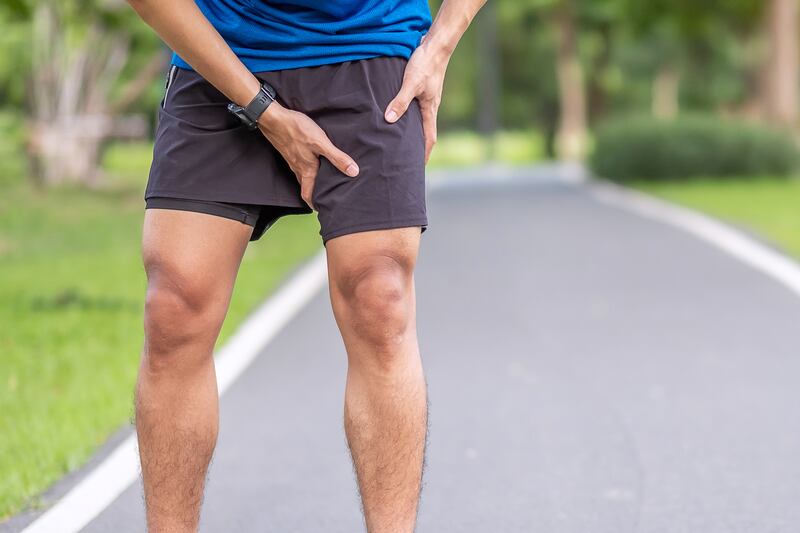
You’re running. Or about to kick a ball. Then suddenly — a sharp pain in the groin. You slow down. Stretch. Rest a few days. It feels better… until you train again. And it comes back.
If this sounds familiar, you might be dealing with pubalgia, often called sports hernia or chronic groin pain.
Let’s clarify what that really means — and why rest alone rarely fixes it.
What Is Pubalgia?
Pubalgia is not a single injury.
It’s a load-related pain condition affecting the region where:
- The adductor muscles (inner thigh)
- The lower abdominal muscles
- The pubic bone
all meet.
This area acts like a force transfer station between your trunk and your legs. When the load exceeds what the tissues can tolerate, irritation develops.
This is common in:
- Football players
- Runners
- Padel and tennis players
- Gym athletes
- Anyone doing repetitive cutting, sprinting, or directional changes
Why Does It Happen?
The most common reason is imbalance between the core and the adductors.
If:
- The core doesn’t stabilize properly
- The glutes are underactive
- The adductors are overloaded
- Training load increases too quickly
The stress concentrates at the pubic attachment.
Over time, this creates:
- Micro-irritation
- Tendon overload
- Persistent groin pain
It’s not usually a tear.
It’s a capacity problem.
Common Symptoms
- Deep groin pain during running or kicking
- Pain when squeezing the knees together
- Discomfort during sudden changes of direction
- Pain when getting out of bed or the car
- Tenderness over the pubic bone
In more advanced cases, even coughing or sneezing can provoke symptoms.
Why Rest Alone Doesn’t Solve It
Many people stop training for 2–3 weeks.
Pain decreases. They return to sport. Pain comes back. Why?
Because the underlying issue — load tolerance and muscle coordination — was never addressed.
Pubalgia improves with:
- Progressive strengthening
- Controlled loading
- Core–hip integration
- Gradual return to sport
Not complete inactivity.
What Should You Actually Do?
1️⃣ Assess Adductor Strength
Adductor weakness compared to the opposite side or to body weight is a major risk factor.
Isometric adductor strengthening is often the first step.
Example:
- Supine ball squeeze holds
- Side plank with adductor activation
2️⃣ Improve Core Stability (But Properly)
This doesn’t mean random abs exercises.
It means:
- Anti-rotation control
- Deep abdominal engagement
- Pelvic stability under load
Exercises like:
- Dead bugs
- Pallof press
- Controlled plank variations
3️⃣ Strengthen the Glutes
Weak glutes increase stress on the groin.
Focus on:
- Hip extension strength
- Lateral hip control
- Single-leg stability
4️⃣ Gradual Return to Running & Kicking
Return-to-sport should follow a progression:
- Pain-free strengthening
- Controlled jogging
- Directional drills
- Speed work
- Sport-specific movements
Skipping steps usually brings the pain back.
When Is It Something Else?
Not all groin pain is pubalgia.
It’s important to rule out:
- True inguinal hernia
- Hip joint pathology
- Labral issues
- Stress fracture
- Nerve-related pain
A proper clinical assessment makes a big difference.
Final Takeaway
Pubalgia is not a “tear that needs rest.”
It’s usually a load management and muscle coordination issue. With the right strengthening approach, most cases improve significantly — even chronic ones.
If groin pain keeps returning every time you try to train, your body is telling you something: It’s not weak. It just needs structured rebuilding.