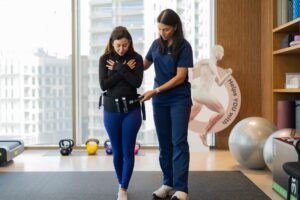
Balance & Proprioceptive Retraining at KINETIKA
Balance is not simply a matter of strength or flexibility. It is the product of a finely tuned sensory-motor control system that integrates information from the joints, muscles, inner ear, and eyes to maintain postural stability and coordinate movement. When this system is disrupted by injury, neurological change, or deconditioning, the result is falls, re-injury, and loss of confidence in movement.

What Is Proprioception?
Proprioception is your body’s internal sense of position, the ability of joint receptors, muscle spindles, and the nervous system to tell your brain exactly where your limbs are in space and how fast they are moving. It is the system that allows you to walk on an uneven surface without looking at your feet, or to catch yourself when you trip.
After any joint injury (a sprained ankle, knee reconstruction, hip replacement) proprioception is significantly impaired. Research consistently shows that without specific retraining, this deficit persists even after pain has resolved and strength has returned, leaving the joint vulnerable to re-injury.
Assessment
KINETIKA’s vestibular and balance physiotherapists use clinical balance assessment to identify exactly where your proprioceptive system is failing. This includes single-leg stance testing under varying visual and surface conditions, dynamic balance tasks assessing anticipatory and reactive postural control, gait analysis, and vestibular-specific testing where indicated.
Retraining Program
Balance and proprioceptive retraining follows a graduated challenge approach:
- Single-leg stance progression, from firm surface, eyes open, to unstable surface, eyes closed
- Perturbation training, controlled destabilisation to train reactive balance responses
- Neuromuscular training, sport-specific movement patterns under increasing complexity and speed
- Dual-task training, combining balance tasks with cognitive or motor tasks, reflecting real-world demands
- Vestibular rehabilitation. Specific gaze stabilisation and habituation exercises where the inner ear is involved
Who Needs Balance Retraining
Balance and proprioceptive retraining is essential following any ankle, knee, or hip injury or surgery, for older adults with falls risk or vestibular dysfunction, in neurological conditions affecting movement control, for athletes returning to sport, and for anyone experiencing persistent instability, dizziness, or loss of confidence in movement.
Vestibular Rehabilitation
Where dizziness, vertigo, or gaze instability is present, KINETIKA’s specialist vestibular physiotherapists provide full assessment including BPPV canalith repositioning (Epley manoeuvre), vestibular habituation exercises, and gaze stabilisation training. Vestibular and balance retraining often occur together, addressing both the sensory input and the motor output components of the balance system.