
Something fundamental changed in how we practise physiotherapy at Kinetika when we introduced KinetiSense™ 3D motion capture. Here’s what we decided, why we decided it, and what it means for every patient who walks through our door.
For most of physiotherapy’s history, assessment has been an art as much as a science. Experienced clinicians watching how someone walks, sits, or reaches overhead. Hands on a joint, estimating range of motion with a goniometer. Pattern recognition built across years of practice, refined by thousands of patients.
That clinical intuition still matters enormously. But there has always been a gap between what we can observe and what is actually happening inside a patient’s movement. Too much depended on the clinician’s vantage point, the angle of the assessment, whether the patient was guarding against anticipated pain.
We wanted to close that gap.
What 2D Assessment Misses
The human body moves in three dimensions. Compensations don’t just happen forwards and backwards, they rotate, shift laterally, fold across planes that are difficult to observe simultaneously. A knee tracking inward during a squat is obvious. But the subtle hip rotation that is causing it? That’s harder to catch with the naked eye, especially when you’re also taking a history, building rapport, and planning treatment at the same time.
This isn’t a criticism of traditional physiotherapy. It’s a structural limitation of human perception. Even the best clinicians in the world cannot simultaneously observe a patient’s full body movement across multiple planes in real time. Something is always missed, and that something is often the root cause.
“With Kinetisense, I can provide objective, real-time data in just minutes, helping patients see their movement dysfunctions, and understand why they’re in pain. That shift in patient understanding changes everything.”
Dr. Christian Barney, ART Instructor, KinetiSense™ Partner
What KinetiSense™ Actually Does
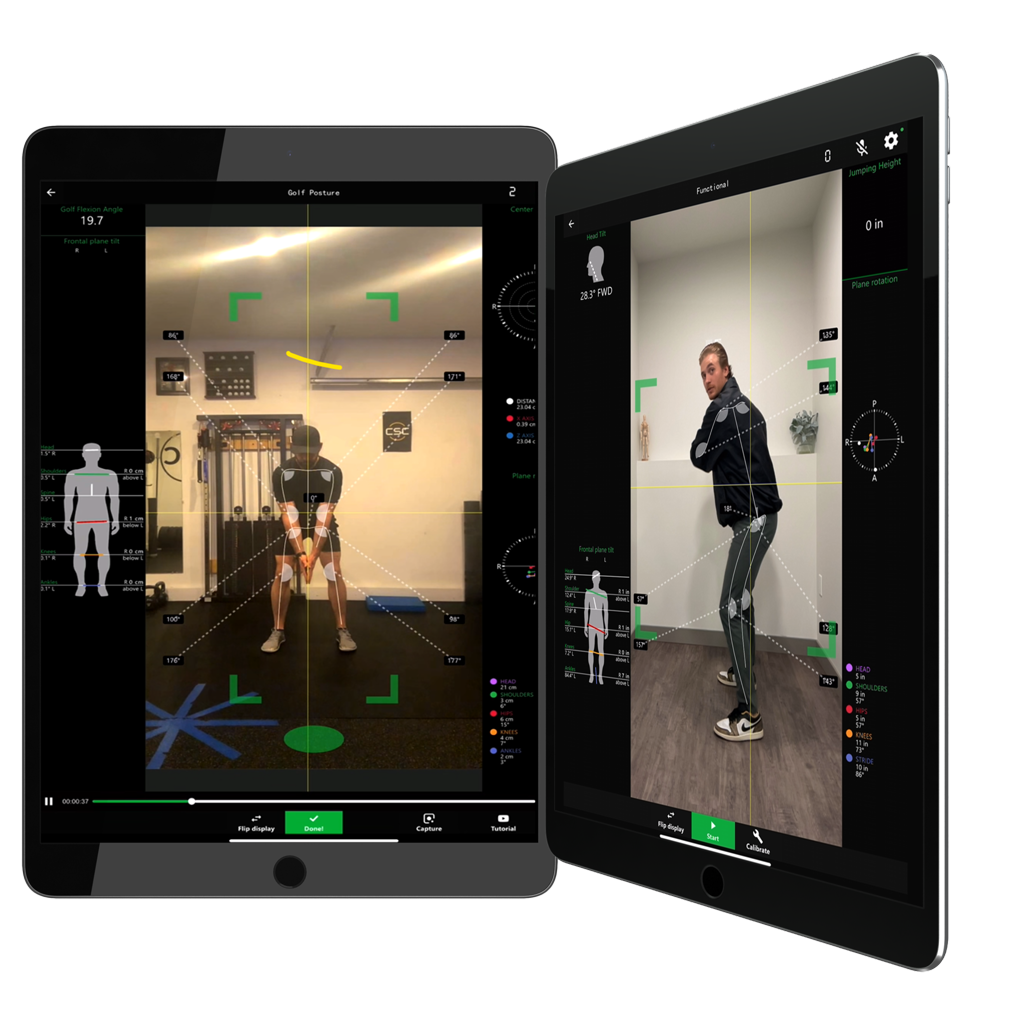
KinetiSense™ is the world’s first patented markerless motion capture system built specifically for clinical physiotherapy. There are no sensors, no wearables, no stickers. The patient simply moves, and the system, running on an iPad, captures over 40 joint range-of-motion measurements simultaneously in real time, across all three planes.
The technology uses computer vision and machine learning to build a 3D model of the patient’s movement. It identifies asymmetries, compensations, and restrictions the moment they occur. Within seconds of the assessment, AI generates a personalised corrective exercise programme matched to the patient’s specific deficits.
The whole process takes under two minutes.
What Changes for Our Patients
The first thing patients notice is the visual. Seeing your own body in 3D, watching your spine load asymmetrically when you thought you were moving straight, seeing the disparity in shoulder rotation displayed objectively on screen, is a completely different experience from being told about it.
One of the most consistent challenges in physiotherapy is patient compliance with home exercise programmes. It’s hard to stay committed when the problem is abstract, when you can’t feel the dysfunction until it becomes pain, and can’t see improvement until it’s obvious. KinetiSense™ changes that dynamic. Every reassessment benchmarks against the original baseline. Patients see their own data improving. That’s motivating in a way that verbal reassurance isn’t.
For our clinical team, the shift is equally significant. Instead of building a picture gradually across multiple sessions, we begin treatment with a precise, objective map of each patient’s movement from day one. That enables better-targeted manual therapy, more specific exercise prescription, and a clearer framework for tracking what’s working, and what needs adjustment.
KinetiSense™ 3D markerless motion capture. No markers, no wearables, just movement, measured with precision.
Not Just for Injury, For Prevention
We’ve always believed that physiotherapy at its best is proactive rather than reactive. The traditional model, wait until you’re in pain, then see a physiotherapist, misses the window when intervention is easiest and most effective.
KinetiSense™ makes the case for preventive physiotherapy in a way that nothing else we’ve used has managed. When a patient can see that their left hip has significantly less internal rotation than their right, and understand that this asymmetry is exactly why their lower back flares up after long runs, they don’t need convincing to do something about it. The data speaks plainly.
We now offer KinetiSense™ movement screens as standalone assessments for athletes, desk workers, and anyone who wants to understand their body before a problem develops. We would rather show you a compensation pattern at 35 than treat its consequence at 50.
What This Means When You Come to See Us
If you’re booking an assessment at Kinetika now, your first appointment includes a KinetiSense™ 3D movement screen as part of our standard initial evaluation. You’ll see your body moving in three dimensions. You’ll receive an objective picture of where your movement is restricted or asymmetrical. And your treatment plan will be built around that data, not only around what you describe or what we observe by eye.
It’s a more precise way to help you. And precision, we believe, is what good physiotherapy is built on.
Ready to see how your body actually moves? Book a movement assessment at our Dubai Hills clinic.