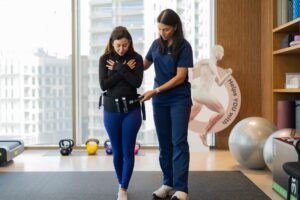
Assisted Stretching at KINETIKA
Stretching that you do alone has real limits. The body’s protective mechanisms, muscle spindle activity, guarding, and the practical difficulty of fully relaxing while simultaneously generating the stretch force. Mean that self-stretching rarely achieves the tissue length that is clinically needed. Assisted stretching, delivered by a trained physiotherapist, works differently.

Techniques We Use
Proprioceptive Neuromuscular Facilitation (PNF) Stretching
PNF is the most effective stretching technique in the clinical evidence base. It uses a combination of isometric contraction, relaxation, and passive stretch to achieve tissue elongation well beyond what passive stretching alone can achieve. The most common PNF methods used at KINETIKA include:
- Contract-Relax, you contract the target muscle against resistance, then relax while your therapist applies a passive stretch
- Contract-Relax-Contract (CRAC), following the passive stretch, you contract the opposing muscle to actively pull into the new range, improving neuromotor control of the gained length
- Hold-Relax, a gentler variant using a sustained isometric contraction, particularly useful in acute or post-surgical presentations
Active Isolated Stretching (AIS)
Short-duration (2-second) stretches performed repetitively, using active contraction of the opposing muscle group to facilitate relaxation of the target muscle. AIS avoids the myotatic stretch reflex that limits the effectiveness of prolonged static stretching.
Passive Stretching with Overpressure
Where joint end-range restriction is the limiting factor, your therapist applies controlled overpressure beyond your comfortable range to address the capsular or ligamentous component of the restriction. This is distinct from muscle stretching and is used in conjunction with joint mobilisation.
What You Gain
Assisted stretching achieves measurable improvements in muscle length, joint range of motion, and movement quality. But the gains must be consolidated. Your therapist will provide you with a home stretching program designed to maintain and build on what is achieved in session. Without this home component, tissue will progressively return toward its prior length.
When We Use Assisted Stretching
Assisted stretching is incorporated wherever muscle shortening or restricted flexibility is contributing to pain, movement limitation, or injury risk. Common applications include hamstring tightness in low back pain, hip flexor shortening with anterior pelvic tilt, calf and Achilles restriction in lower limb presentations, thoracic and cervical mobility for postural pain, and pre- and post-athletic performance.