
Vestibular care · Dubai Hills
Specialist vestibular rehabilitation in Dubai Hills for dizziness, vertigo and imbalance. Equipment-backed testing with a vestibular physiotherapist.
Senior Physiotherapist, vestibular and balance lead
You turn in bed and the room spins hard for 20 seconds. It settles, then it happens again the next morning. Or nothing spins at all, and you just feel foggy, unsteady and not yourself.
Many people brace on walls, furniture and handrails without noticing they have started. Others stop driving, because a shoulder check on Al Khail Road feels genuinely unsafe.
These are three different problems, and the difference guides treatment. Vertigo is a false sense of movement, usually spinning, and it often comes from the inner ear. Dizziness is lighter-headed or foggy, and it has a much wider list of possible causes. Imbalance is unsteadiness on your feet, often with no spinning at all.
Most people who reach our Dubai Hills clinic have already had an MRI scan and blood tests. Both were normal. Nobody had tested the vestibular system, which is the balance organ in the inner ear and the reflexes it drives.
You may have been told it is stress, or anxiety, or simply age. A vestibular physiotherapist tests that system directly, then treats what the testing shows.
Each of these responds to a different approach, which is why we assess before we treat.
Your first appointment is an assessment, not a treatment session with a guess attached.
We start with your history. When it started, how long each episode lasts, what position or place provokes it, and what you have stopped doing because of it. That history alone narrows the field considerably.
We then test. We watch your eyes during specific head and body positions. We test how steady your vision stays while your head moves. We check standing balance, walking, neck movement and blood pressure on standing.
The purpose is to separate an inner-ear cause from a central cause, a neck-related cause or a blood pressure cause. Each leads to a different plan.
Where testing points to a cause that needs an ENT specialist, a neurologist or a cardiologist, we say so and work alongside them. GPs and specialists across Dubai Hills and Meydan refer patients to us for exactly this assessment.
Very few physiotherapy clinics in Dubai own vestibular testing equipment. The instruments we use are the kind usually found in audiology and ENT clinics. Most physiotherapy clinics rely on watching your eyes in a lit room, which hides the small movements that carry the diagnosis.
You wear a pair of lightweight goggles with an infrared camera inside. The room goes dark, so you cannot fix your gaze on anything, and your eye movements appear on our screen. Removing visual fixation is what makes a subtle inner-ear response visible. This is videonystagmoscopy, or VNS.
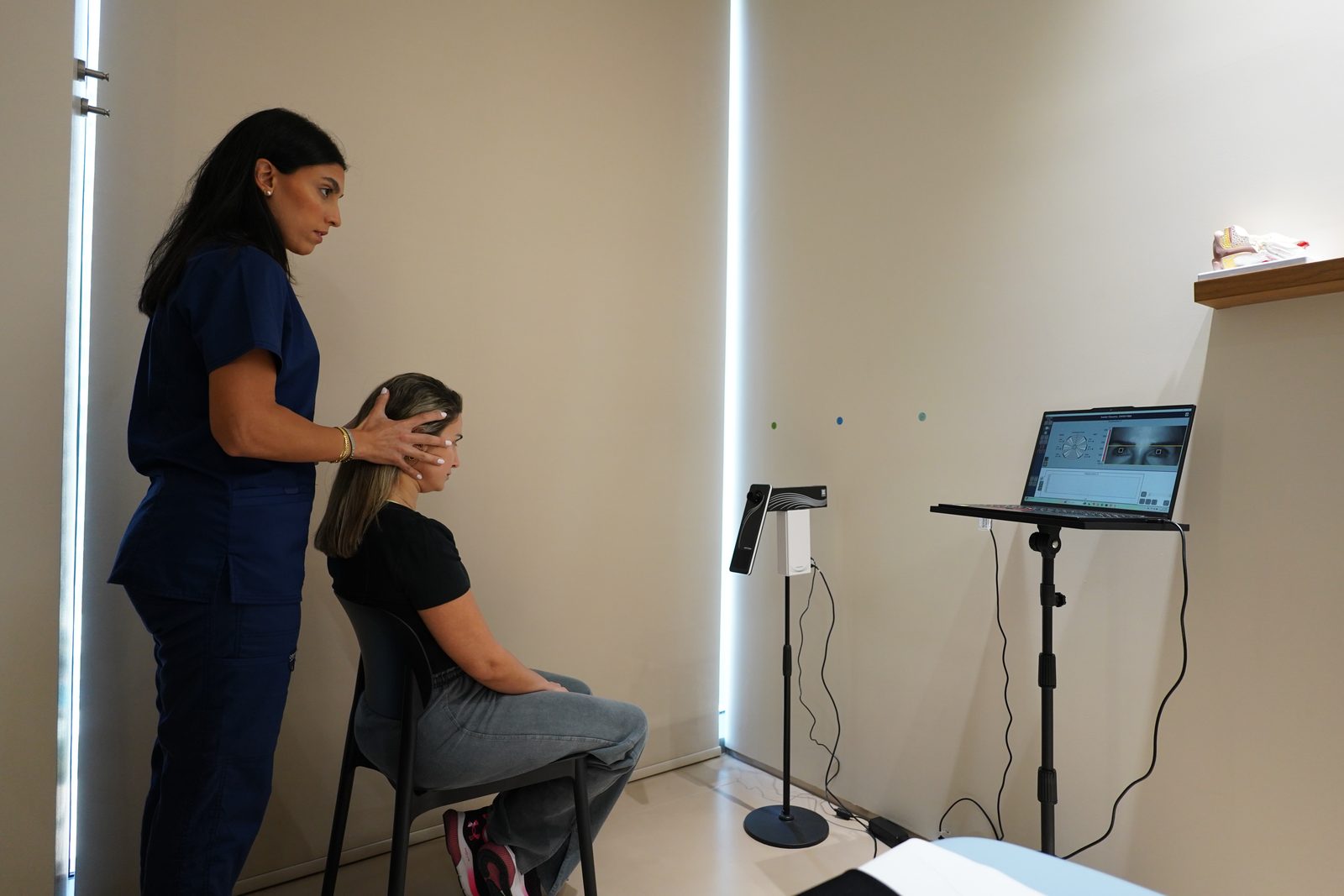
You sit and look at a target while we turn your head quickly through a small range. Nothing is fitted to your head. A high-speed camera in front of you records whether your eyes stayed locked on the target or slipped and corrected, while your physiotherapist performs the head impulses from behind. This is the video head impulse test, or vHIT. It takes under five minutes, it is not painful, and it measures the reflex that keeps vision steady when you move, for each of the six semicircular canals.
We rest a small vibrating device on the bone behind your ear for a few seconds. If one balance organ is weaker than the other, the vibration produces an eye response we can record. This is the skull vibration test, and it helps identify an imbalance between the two sides.
Testing gives us a baseline. It also lets us repeat the same measurements after five sessions and show you what changed.
Your programme is built from the findings, not from a template.
For BPPV, we use repositioning manoeuvres such as the Epley or Semont, chosen for the specific canal involved.
For a weak or under-compensated balance system, we use gaze stabilisation exercises. You hold a target steady while your head moves, which trains the reflex to work accurately again.
For motion and visual sensitivity, we use habituation and graded exposure. We give you small, repeated doses of the movement that provokes you, then increase them as your tolerance grows. Where visual dependence is part of the picture, we use optokinetic stimulation, a large moving pattern of stripes or dots, to retrain how much your balance relies on vision.
For unsteadiness, we use balance and strength work on progressively harder surfaces and with reduced visual input.
For neck-related dizziness, we add manual therapy and neck control exercises.
Everything is dosed to a level you can tolerate. Brief symptoms during exercises are expected and are part of how the brain adapts. Where it suits your case, you also get a short home programme. How much and how often depends on your findings, and some people do all of their rehabilitation in the clinic.
This depends entirely on the cause, and we give you an estimate at the end of your first assessment.
BPPV commonly settles within 1 to 3 sessions once the affected canal is identified. Vestibular neuritis and labyrinthitis usually need 6 to 12 weeks of graded rehabilitation. Vestibular migraine and PPPD often run 8 to 12 weeks, and they progress alongside medical management rather than instead of it.
Older adults working on falls prevention often continue longer, because strength and confidence build slowly.
If you are not improving by the point we expected, we say so, retest, and change the plan or refer you.
Nour Salman leads vestibular and balance physiotherapy at KINETIKA. She has 8 years of clinical experience and earned her degree in physiotherapy at Saint Joseph University of Beirut.
She completed advanced vestibular training at the American Institute of Balance and a specialist vestibular internship in France. Before joining KINETIKA she worked at Cleveland Clinic Abu Dhabi, where she helped develop vestibular and maxillofacial rehabilitation services.
Nour has delivered more than 10 local lectures and presented at more than 7 international conferences. She treats in English, Arabic and French. KINETIKA is a DHA-licensed clinic.
Your first appointment is a full vestibular assessment and includes the equipment testing described above. Where it is appropriate, treatment is initiated in that same session.
Most insurances accepted. You pay at the time of your visit, and we give you a detailed invoice and, where your insurer requires one, a treatment report. Our team can talk you through what your provider needs.
We are at Unit 403, Floor 4, Park Heights Square 1, Al Khail Road, Dubai Hills, a few minutes from Dubai Hills Mall. Parking is available in the building.
Common questions
Dizziness should be medically assessed urgently if it starts suddenly or is accompanied by symptoms such as severe or unusual headache, weakness or numbness, difficulty speaking, facial drooping, fainting, chest pain, new vision changes, or difficulty walking. If your symptoms are persistent, recurrent, or unexplained, a vestibular assessment can help determine whether rehabilitation is appropriate or whether further medical evaluation is needed.
Vertigo is a false sense of movement, usually spinning. Dizziness is a broader feeling of light-headedness, fogginess or unsteadiness without spinning.
Those tests examine brain structure and blood chemistry. They do not measure how your inner ear and balance reflexes function. That needs separate testing.
Some exercises briefly provoke symptoms, and that is part of how the brain adapts. We dose them so the symptoms settle within hours and reduce over the weeks.
Vestibular testing is generally safe and well tolerated. Certain tests may not be suitable for patients with specific neck or spinal conditions, recent head or neck injuries or surgery, certain vascular conditions, or other relevant medical conditions. Before testing, our physiotherapist will review your medical history and determine which assessments are safe and appropriate for you.
Yes. Physical therapy is the American term for physiotherapy. Vestibular rehabilitation is the branch of physiotherapy that treats the balance system.
Allow 60 minutes. That covers your history, the equipment testing, an explanation of the findings and, where appropriate, the start of treatment.
If your dizziness is currently triggered by head movement, please arrange a lift. Repositioning treatment can leave you unsteady for a short period afterwards.
We are in Dubai Hills, at Unit 403, Park Heights Square 1 on Al Khail Road. We see patients from Dubai Hills, Meydan, Al Barsha, Business Bay and Downtown.
BPPV can recur. If it does, our specialist will guide you on how to manage it until you are able to come to the clinic, so she can help you properly. For other causes, we retest at the end of your programme and give you a maintenance plan.
Yes. Our paediatric and vestibular physiotherapist, Jimy Haddad, assesses balance concerns in children, and we refer to paediatric ENT where that is the right pathway. Please call first so we can advise.
Yes. Anxiety and a sensitised balance system feed each other. Assessment tells us whether a treatable vestibular component is present.
Bring any MRI or CT reports, any vestibular test results you already have, your physician's report, a list of your current medications, and notes on when your symptoms began and what provokes them.
Related vestibular care
Dubai Hills
Allow 60 minutes for your first appointment. Unit 403, Floor 4, Park Heights Square 1, Al Khail Road, Dubai Hills.
Medically reviewed by the Kinetika Clinical Team · Last reviewed 29 September 2026