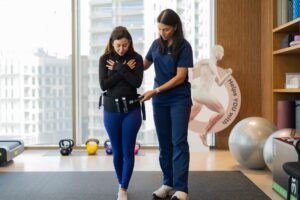
Kinesiology Taping

Kinesiology Taping Supporting movement without restriction. Kinesiology tape is a flexible, breathable tape applied to muscles or joints to support alignment, improve movement, and reduce discomfort.

— min read

Supporting movement without restriction.

Kinesiology tape is a flexible, breathable tape applied to muscles or joints to support alignment, improve movement, and reduce discomfort. It moves with your body while still providing gentle stability and sensory feedback.

Why it
works

The tape gently lifts the skin to improve circulation and relieve pressure on sensitive areas. It also enhances body awareness by sending signals to the nervous system, which can help guide posture and movement patterns.

What to
expect

Your physiotherapist will apply the tape in a specific direction and shape, depending on your needs. It usually stays on for several days and can be worn during exercise, work, or daily activity. It is water-resistant and easy to wear.

Why clients
value it

It provides support without limiting movement. Many people feel more confident and stable, especially during sport, rehabilitation, or after injury. It is a simple but effective way to extend the benefits of your physiotherapy sessions.

Jimy Haddad
Physiotherapist

Years of Experience: 7+ years
Languages: English, French, Arabic

Expertise

Ahmad Al Nazer
Physiotherapist

Expertise

Years of Experience: 7+ years
Languages: English, Arabic

Your Next Step

Ready to move better?

Book a consultation with one of our expert physiotherapists and start your recovery today.

Book a Consultation

Optokinetic Stimulation

Optokinetic stimulation is a treatment tool that uses moving visual patterns (like stripes or dots) to help desensitise the brain to motion and reduce symptoms of dizziness, disorientation, or visual overload. It’s particularly helpful when visual environments trigger or worsen your symptoms.

Read More »

Skull Vibration Test

The Skull Vibration Test uses a gentle vibration behind the ear to stimulate the balance organs of your inner ear and detect if there’s a difference between the left and right sides. It is often used as a simple but powerful screening tool when dizziness or imbalance seems one-sided.

Read More »

Videonystagmoscope (VNS)

VNS is a diagnostic tool that uses infrared video goggles to directly observe and analyse eye movements in real time. Since the eyes and inner ear are functionally linked, monitoring these movements helps determine whether a patient’s dizziness or imbalance is related to peripheral vestibular dysfunction or central causes.

Read More »

Video Head Impulse Test (VHIT)

The VHIT evaluates how well your vestibulo-ocular reflex (VOR) is working — the reflex that keeps your eyes steady when your head moves. It helps us determine whether your inner ear canals are functioning properly, especially when you feel dizzy or unfocused during quick movements.

Read More »

Physiotherapy for Every Body, Every Day

Physiotherapy is not just for when something goes wrong — it is for keeping things right. At KINETIKA in Dubai Hills, we combine precision assessment with evidence-based care to help you move better and live stronger.

Read More »

Why We Now Assess Every Patient in 3D

Something fundamental changed in how we practise physiotherapy at Kinetika when we introduced KinetiSense™ 3D motion capture. Here’s what we decided, why we decided it — and what it means for every patient who walks through our door.

Read More »