Written by the Kinetika Team, Kinetika Physiotherapy · Reviewed: October 2026
On Sunday 1 November 2026, Sheikh Zayed Road swaps cars for bicycles for Dubai Ride. Families from Dubai Hills and Arabian Ranches will be on the 4 km route, and keener riders on the 12 km route. A lot of those bikes will be hired on the morning, borrowed from a neighbour, or pulled out of the storeroom for the first time since last year’s ride. That is part of the fun. It is also why, on the Monday after, we tend to hear about stiff necks and sore lower backs.
Most of this can be eased or avoided with a few minutes of setup, a short warm up and some simple mobility afterwards. Here is what we suggest.
Why necks and lower backs get sore on the bike
Cycling asks your body to hold one position for a long time. You lean forward from the hips, your arms take some of your weight, and you tilt your head back to look up the road. That last part is the one most people do not notice. The further forward you lean, the more your neck has to extend to keep your eyes on the road ahead, and the muscles at the base of your skull and across the tops of your shoulders work hard the whole way.
Your lower back does something similar. If you are stretched out, or the saddle is at the wrong height, your pelvis tips and your lower back holds one position for the whole ride. Add tight hamstrings and hips from a week of sitting, and your back ends up doing work your hips should share.
Some other common contributors:
- A bike that is not your size. Hired and borrowed bikes are set for someone else, and a small mismatch in reach or saddle height adds up over 12 km.
- Gripping too tightly. Tense hands and arms feed straight into tense shoulders and neck.
- A helmet tilted too far forward. If the front rim sits low over your eyes, you have to push your head back further to see.
A five minute setup for a hired or borrowed bike
You do not need a professional bike fit for a fun ride, but a few quick checks help.
Saddle height
Sit on the saddle and put your heel on the pedal at its lowest point. Your leg should be almost straight. When you then ride with the ball of your foot on the pedal, your knee will have a gentle bend at the bottom of the stroke. If your knee is very bent, the saddle is too low, which strains the knees and hips. If your hips rock from side to side as you pedal, it is too high, and your lower back will feel it.
Saddle angle
Aim for a roughly level saddle. A nose tipped down slides you forward onto your arms and neck; tipped up, it can irritate the lower back.
Reach to the handlebars
With your hands on the grips, your elbows should be soft, not locked, and you should be able to look up the road by lifting your eyes rather than cranking your head right back. If you feel stretched out, move the saddle forward slightly if it allows, or ask the hire staff for a smaller frame or a more upright bike. On a family ride, upright is fine.
Quick safety checks
Squeeze both brakes, check the tyres are firm, and make sure your helmet sits level on your head, about two fingers above your eyebrows, with the straps snug.
A simple warm up before you roll
Five minutes near the start line is enough. Move slowly and within comfort.
- Chin tucks: gently draw your chin back, as if making a double chin, and release. 10 times.
- Neck turns: look slowly over each shoulder, 5 times each side.
- Shoulder rolls: 10 backwards circles, keeping the movement easy.
- Hip hinges and leg swings: 10 swings forward and back on each leg, holding onto the bike for balance.
Then spend the first kilometre spinning an easy gear. It is not a race, and your back will thank you.
After the ride: mobility for your neck and lower back
When you finish, take a short walk before getting back in the car, then try a few gentle movements.
- Chin tucks and neck turns: the same as your warm up, 10 each.
- Upper back extension: sit on a chair, hands behind your head, and gently arch your upper back over the backrest. 8 slow repetitions.
- Doorway chest stretch: forearm on a door frame, step through gently until you feel a stretch across the front of your chest. 30 seconds each side.
- Knee hugs: lying on your back, bring both knees towards your chest. 30 seconds.
- Lying rotation: knees bent, let them fall slowly to one side and then the other. 10 times.
Mild stiffness the next day is common after an unfamiliar ride and usually eases within a day or two with gentle movement.
When to see a doctor, and when a chiropractic or physio check is worth it
Please see a doctor, or go to emergency care, if you have:
- Neck pain after a fall or collision, especially with a head knock, dizziness or confusion.
- Numbness, tingling or weakness spreading into your arms or legs.
- Numbness around the saddle area, or any change in bladder or bowel control.
- A sudden severe headache, changes in your vision, or difficulty speaking or swallowing.
- Back or neck pain with fever, feeling generally unwell, or unexplained weight loss.
- Pain that is constant, severe and not affected by position, or that wakes you every night.
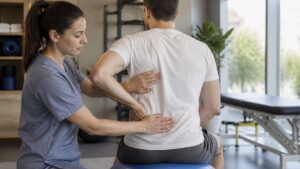
For everyday aches, a check is worth booking if stiffness lasts more than a few days, keeps coming back every time you ride, or if pain spreads into your shoulder blade or arm. Our neck pain assessments look at how your neck, upper back and shoulders move together, and at the habits that load them.
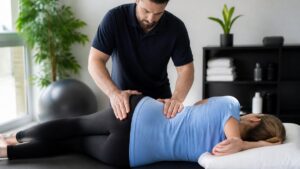
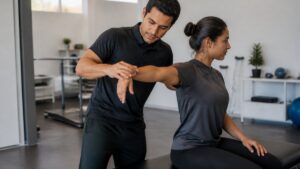
At KINETIKA, you can see a physiotherapist or our chiropractor, Ali Deniz Baykara, who speaks English and Turkish. Our chiropractic care combines hands on techniques with exercise and advice, and our physiotherapy team focuses on movement, strength and a plan you can follow at home. After an assessment, we will suggest the approach that suits your situation.
Frequently asked questions
Is it normal to have a stiff neck after cycling?
Mild stiffness after an unfamiliar ride is common, especially on a bike that does not fit you. If it lasts more than a few days, keeps returning, or comes with arm symptoms, get it checked.
Can I ride Dubai Ride with a sore back?
Many people with mild, familiar back stiffness ride comfortably on the 4 km route with a good setup and an easy pace. If your pain is recent, severe, or spreads down your leg, get it assessed first and follow the advice you are given.
How high should my saddle be?
With your heel on the pedal at its lowest point, your leg should be almost straight. Riding with the ball of your foot, that leaves a gentle bend in the knee at the bottom of each stroke.
Should I see a chiropractor or a physiotherapist?
Both can help with neck and lower back pain after cycling. At KINETIKA, we start with an assessment and then recommend chiropractic care, physiotherapy, or a combination, depending on what we find and what you prefer.
Dubai Ride is one of the city’s most joyful mornings, and a few minutes of preparation means you can enjoy it and still feel good on Monday. If your neck or back is complaining before or after the ride, our team at Park Heights Square 1 in Dubai Hills is here to help. Book an assessment