Written by the Kinetika Team, Kinetika Physiotherapy · Reviewed: September 2026
Dizziness can be frightening, especially when it comes on suddenly. Whether the room is spinning, you feel lightheaded, or you suddenly feel unsteady, the first priority is safety.
1. Sit down or lie down
If you suddenly feel dizzy, stop what you’re doing and sit somewhere safe. If you feel that you may fall, lie down until the strongest symptoms settle.
Don’t try to “walk it off” while you’re unsteady.
When you feel better, get up slowly and carefully.
2. Make your surroundings safe
While you’re dizzy:
- Turn on the lights.
- Avoid stairs.
- Stay away from slippery surfaces.
- Use a stable surface for support if needed.
- Don’t drive or climb until you feel steady again.
The goal is simple: don’t let a dizzy episode turn into a fall.
3. Move slowly
Sudden head or body movements can sometimes make dizziness worse.
If you’re getting out of bed, sit on the edge first, give yourself a moment, then stand.
If you regularly feel dizzy when standing up, don’t simply assume it’s an inner-ear problem. It is worth discussing with your doctor.
4. Don’t automatically do an Epley manoeuvre
You’ve probably seen videos telling you to do the Epley manoeuvre whenever you feel dizzy.
But the Epley is designed for a specific type of BPPV, not dizziness in general.
If your dizziness has not been properly assessed, performing a manoeuvre at random may not help.
A vestibular assessment can determine whether BPPV is present and, if so, which treatment is appropriate.
5. Pay attention to the episode
Once you’re feeling better, think about what happened:
- Did the room spin?
- Did you feel faint?
- Did you feel pulled to one side?
- Did it happen when you rolled over, bent down or looked up?
- Did you have a headache, nausea, or sensitivity to light or sound?
These details can help your healthcare professional understand what may be causing your dizziness.
6. Know when to seek urgent medical help
Dizziness should not always be assumed to be an inner-ear problem.
Seek urgent medical attention if dizziness occurs with new weakness or numbness, difficulty speaking, double vision or vision loss, fainting, a severe or unusual headache, significant difficulty walking, chest pain, or other sudden neurological symptoms.
If you’re unsure, it’s safer to seek medical advice rather than trying to diagnose yourself at home.
What if it keeps happening?
Recurring dizziness deserves an assessment.
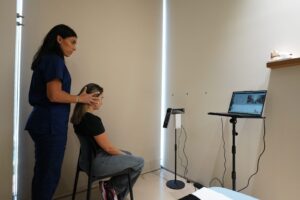
A vestibular physiotherapist can assess your symptoms, balance, eye and head movements, positional responses and motion tolerance to help determine what may be contributing to your dizziness.
Depending on the cause, treatment may include repositioning manoeuvres, balance training, gaze-stability exercises, habituation or gradual exposure to movement.
Remember:
Stop → Sit or lie down → Make yourself safe → Let the symptoms settle → Move slowly → Seek medical help if there are warning signs.
If dizziness keeps coming back, don’t just keep treating the symptom.
Find out why it’s happening.
Read next
About the author
Nour Salman is a Senior Physiotherapist at KINETIKA in Dubai Hills, specialising in vestibular and balance rehabilitation. She sees patients in English, French and Arabic.
Your next step
Dizziness or motion sensitivity that keeps coming back? Book a vestibular assessment at KINETIKA, Park Heights Square 1, Dubai Hills. Book online or Message us on WhatsApp.