Written by the Kinetika Team, Kinetika Physiotherapy · Reviewed: October 2026
The school football season is in full swing across Dubai Hills, and weekday evenings now mean training at the academy, matches at the weekend and a garden kickabout in between. Then comes the October mid-term break, 12 to 16 October for most schools this year (check your own school calendar). For many families that means football camps, trampoline parks and long days of running around. It is also the time of year when we hear a familiar question from parents: “Why is my child limping off the pitch, holding their heel?”
In active children aged about 8 to 14, the most common answer is Sever’s disease. It sounds alarming, but it is not really a disease at all, and with the right plan most children keep playing the sport they love.
What is Sever’s disease?
Sever’s disease, or calcaneal apophysitis, is irritation of the growth plate at the back of the heel bone. In growing children this area is still partly made of cartilage, which is softer than adult bone. The Achilles tendon, the thick cord at the back of the ankle, attaches just above it, and the strong calf muscles pull on it with every step, sprint and jump.
During a growth spurt, the bones often grow faster than the muscles and tendons can lengthen, so the calf becomes relatively tight and pulls harder on the heel. Add running on hard pitches, plenty of jumping and boots with little cushioning, and the growth plate gets sore. It usually appears between the ages of 8 and 14, a little earlier in girls than in boys, and it often affects both heels.
The good news is that Sever’s settles once the growth plate matures and fuses with the rest of the heel bone. Until then, our job is to calm the heel down and keep your child moving.
Warning signs to look out for
Children do not always tell us about pain, especially if they are worried about missing a match. Look out for:
- pain at the back or bottom of the heel during or after running and jumping;
- limping, walking on tiptoes or avoiding putting the heel down after training;
- stiffness or heel pain first thing in the morning;
- pain when you gently squeeze both sides of the back of the heel;
- pain that eases with rest and returns with sport;
- a recent growth spurt, new boots or a sudden increase in training.
Using the mid-term break wisely: managing load
With Sever’s, the heel is asking for less load for a while, not total rest. Complete rest can leave children frustrated and deconditioned, and the pain often comes straight back when they return. The aim is to find the amount of activity the heel can tolerate.
A practical approach over the October break:
- Use a simple pain scale. Ask your child to score pain from 0 to 10. Mild discomfort of up to about 3 out of 10 during activity, which settles by the next morning, is usually acceptable. If pain goes higher, limps are appearing or the heel is worse the next day, cut back.
- Choose camps with care. A full day football camp, five days in a row, is a big jump in load. Half days, or alternating days, are often kinder to a sore heel.
- Swap some running for low impact activity. Swimming and cycling keep fitness up while the heel settles.
- Avoid barefoot running and jumping. Trampoline parks and running barefoot on hard floors often flare symptoms.
- Ice after activity. Ten to fifteen minutes with an ice pack wrapped in a cloth can ease soreness.
Talk to your child’s coach too. Most academy coaches in Dubai are used to growing players and can adjust sprint and jump volume for a few weeks.
Calf flexibility, strength and footwear
Because tight calves are part of the problem, gentle calf stretches once or twice a day can help. Keep them comfortable: a stretch, not pain. As the heel settles, we add strength work, such as slow calf raises, so the calf and Achilles tendon can handle training loads again.
Footwear matters more than many families expect. Check that football boots still fit after a growth spurt, and look for trainers with a cushioned, slightly raised heel for school and everyday wear. Moulded studs on artificial grass and very flat boots can increase strain on the heel.
When do insoles help? A small heel raise or a cushioned insert can take some pull off the heel in the short term. If your child also has flat feet, feet that roll in, or pain that keeps returning, a biomechanical assessment and custom insoles may help spread the load.
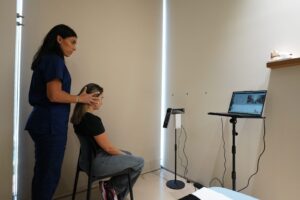
When does physiotherapy help? If heel pain lasts more than two weeks despite easing off, keeps coming back, or stops your child playing, it is worth an assessment. At KINETIKA, children are seen by Jimy Haddad, our paediatric physiotherapist. Jimy checks the heel, calf flexibility, strength, foot posture and running pattern, then builds a plan around your child’s school and training timetable, with clear guidance for parents and coaches. Read more about our physiotherapy for children in Dubai Hills.
When to see a doctor
Sever’s has a very typical pattern. Please see a doctor rather than waiting it out if you notice any of the following:
- heel pain at night or at rest that wakes your child;
- swelling, redness or warmth around the heel;
- fever, or your child seems generally unwell;
- a limp that does not settle after a few days of reduced activity;
- pain in one heel after a fall, twist or other injury;
- pain that is getting worse despite rest, or pain in other joints as well.
These signs can point to other problems, such as a stress fracture or an infection, that need medical assessment and sometimes an X-ray.
Frequently asked questions
Does my child need to stop football completely?
Usually not. Most children can keep training with some changes to how much they run and jump, guided by pain. We aim to keep them involved with their team while the heel settles.
How long does Sever’s disease last?
It varies. Many children have flare ups on and off for several months, often linked to growth spurts and busy seasons. It settles for good once the growth plate matures, usually in the early to mid teens.
Will Sever’s cause long-term damage?
Sever’s is not known to cause lasting problems once the growth plate has matured. Managing it well mainly helps your child stay comfortable and active in the meantime.
Can adults or older teenagers get Sever’s?
No. Once the heel growth plate has fused, Sever’s cannot happen. Heel pain in older teenagers and adults usually has a different cause and needs its own assessment.
If your child is limping after football, or you would like a plan to get them through mid-term camps comfortably, Jimy would be glad to see them at our clinic in Park Heights Square 1, Dubai Hills. Book an assessment