Written by the Kinetika Team, Kinetika Physiotherapy · Reviewed: October 2026
Hatta hiking season is back. Hatta Resorts reopened on 28 September, and for many Dubai Hills families the weekend plan now involves an early drive out past the dam, a trail through the Hajar Mountains and, for the brave, a night under canvas. Then something odd happens. You stop to look up at a ridgeline and the world tilts. You lie down in the tent and the roof seems to spin. Or you roll over in your sleeping bag at 2am and feel as though the ground has dropped away. It passes in less than a minute, but it is unsettling, and it tends to happen again.
If that sounds familiar, one of the most common explanations is something called benign paroxysmal positional vertigo, or BPPV. The name is a mouthful, but the idea is simple, and the good news is that it usually responds well to treatment.
What BPPV is, in plain words
Deep inside each inner ear is a balance system that tells your brain how your head is moving. Part of it contains tiny crystals of calcium carbonate, often called ear crystals, which normally sit in one area and help you sense gravity. Sometimes a few of these crystals come loose and drift into one of the fluid filled canals that sense head rotation.
When you move your head in certain directions, those loose crystals roll through the canal and drag the fluid with them. Your brain receives a strong “we are spinning” message that does not match what your eyes and body are telling it. The result is a short, intense spin, often with nausea, that settles once the crystals come to rest.
BPPV can follow a knock to the head, a viral illness or a long period lying still, and it becomes more common as we get older. Often, though, there is no obvious reason at all.
Why looking up, lying down or rolling over sets it off
The pattern is what gives BPPV away. The dizziness is triggered by particular head positions, not by standing still. Common triggers include:
- Tipping your head back to look up at a peak, a high shelf or the stars.
- Lying down flat, for example on a camping mat.
- Rolling over in bed, often more to one side than the other.
- Bending forward to tie your boots or pick something up, then coming back up.
Each episode usually lasts less than a minute. In between, you may feel a little off balance or queasy, but you are not constantly spinning.
If it happens on the trail
Stop, sit or crouch down safely away from any edge, and keep your head still until the spin passes. Move slowly afterwards, avoid scrambling or exposed sections, and let your group know. Hydration and shade matter in Hatta too, because heat and dehydration can cause light headedness of their own. If this is the first time you have felt dizzy, or it does not follow the positional pattern above, read the red flags below before you carry on.
How BPPV is tested
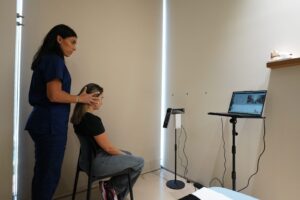
At KINETIKA, dizziness assessments are led by Nour Salman, who works in vestibular rehabilitation. She will start by listening to your story: what brings the dizziness on, how long it lasts, and what else you notice. That history alone tells us a lot.
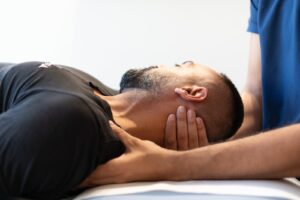
She will then use simple positional tests, such as the Dix Hallpike test and the supine roll test. These involve moving you carefully from sitting to lying with your head turned in specific directions while she watches your eyes. When BPPV is present, the eyes make a characteristic flicking movement called nystagmus, and the pattern tells her which ear and which canal is involved. The tests can briefly bring on your dizziness, which is normal and useful, and Nour will support you throughout.
She will also check other parts of your balance system and look for anything that does not fit BPPV, so that other causes are not missed. You can read more on our vertigo and BPPV treatment page.
How it is treated
BPPV is managed with repositioning manoeuvres. These are a sequence of guided head and body positions, such as the Epley manoeuvre, designed to roll the loose crystals out of the canal and back to where they cause no trouble. The manoeuvre chosen depends on which canal is affected.
Many people notice a clear improvement quickly, and BPPV usually settles in 1 to 3 sessions. We arrange follow up visits twice a week so that we can recheck your positional tests and repeat the manoeuvre if needed. After each manoeuvre, we give you a dos and don’ts sheet covering how to sleep, move and go about your day for the next little while, which helps the crystals stay put.
We do not give medication advice. If you have been prescribed something for dizziness, please discuss it with your doctor. Nour may also add balance exercises if you feel unsteady once the spinning has settled. More detail on the approach is on our BPPV treatment page.
It is important to say that BPPV is one cause of dizziness among many. Inner ear inflammation, vestibular migraine, blood pressure changes, dehydration, medication side effects and other conditions can all make you dizzy. If your symptoms do not fit the BPPV pattern, we will tell you and help you get to the right care.
When to see a doctor or seek emergency care now
Please call for emergency help or go to the nearest emergency department straight away if your dizziness comes with any of the following:
- A sudden, severe headache, unlike any you have had before.
- Double vision or loss of vision.
- Slurred speech or difficulty finding words.
- Weakness or numbness in the face, arm or leg.
- Trouble walking, or being unable to stand without falling.
- Sudden hearing loss.
- Dizziness after a head injury.
These are not typical of BPPV and need urgent medical assessment. Constant dizziness that lasts for hours or days, rather than brief position triggered spins, should also be checked by a doctor.
Frequently asked questions
Why do I feel dizzy when looking up?
Brief dizziness when you tip your head back is a classic BPPV pattern, caused by loose ear crystals moving in the inner ear. It is worth having it assessed so that the cause can be confirmed and treated.
What does a repositioning manoeuvre feel like?
It is a gentle, guided sequence of positions on a treatment couch. You may feel a short spell of dizziness or nausea during it, which usually settles quickly, and we move at a pace that suits you.
Can I still go hiking in Hatta?
Once your BPPV has settled and you feel steady, most people return to hiking. Until then, avoid exposed trails and scrambling, and follow the dos and don’ts sheet we give you after treatment.
Can BPPV come back?
Yes, it can return, sometimes months or years later. The good news is that it usually responds to the same treatment, and knowing the signs means you can get help early.
If the dizziness starts at home rather than on the trail, Nour’s checklist What should I do if I suddenly feel dizzy at home? walks you through the first steps.
A spin on the trail is a strange feeling, but it is often very manageable once the cause is clear. If looking up, lying down or rolling over is making your world tilt, Nour and our team at Park Heights Square 1 in Dubai Hills can help you get back to your weekends. Book an assessment