Written by the Kinetika Team, Kinetika Physiotherapy · Reviewed: October 2026
Have you ever felt perfectly fine at home, only to become nauseous, dizzy, sweaty or uncomfortable the moment you get into a car, boat or plane? You may be experiencing motion sickness.
Motion sickness is not simply a “weak stomach”. It is closely related to the way your brain processes information from your eyes, inner ears and body.
What causes motion sickness?
Your brain constantly combines information from these systems to understand where you are and how you are moving.
Your inner ears detect movement and acceleration. Your eyes provide information about what you see around you, while your muscles and joints tell your brain about your body’s position.
Usually, these signals agree. Motion sickness can occur when they don’t.
For example, when you read or look at your phone in a moving car, your eyes are telling your brain that you are relatively still, while your inner ears are detecting acceleration, turning and braking. This sensory mismatch can trigger nausea, dizziness, sweating, headache and fatigue.
But there is another important part of the story:
YOUR BRAIN CAN LEARN.
Your brain can adapt to motion
Your nervous system is adaptable. With repeated and appropriate exposure to movement or visual stimuli, your brain can gradually become better at processing them. This is known as habituation or adaptation, and it is one of the principles used in vestibular rehabilitation.
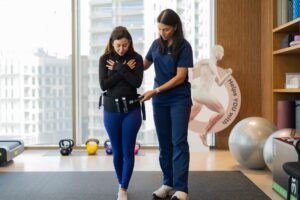
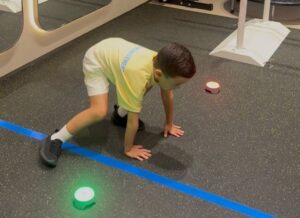
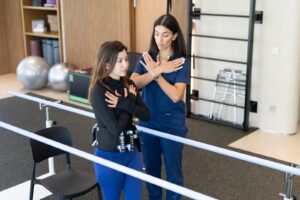
Rather than avoiding every movement that makes you uncomfortable, a vestibular physiotherapist may gradually expose you to specific movements or visual environments that provoke your symptoms.
The goal is not to make you as dizzy as possible. It is to provide the right amount of challenge, at the right pace, so your nervous system can gradually become less sensitive to the stimulus.
So, can vestibular rehabilitation help?
Vestibular rehabilitation is not a single exercise or treatment. Your physiotherapist first needs to understand why movement is provoking your symptoms.
Depending on your assessment, rehabilitation may include:
- gaze-stability and eye-head coordination exercises
- gradual exposure to head and body movements
- balance and walking exercises
- exposure to visually busy environments
- carefully graded visual-motion exercises
- functional activities that reproduce real-life challenges
For people who are particularly sensitive to supermarkets, crowds, airports, scrolling or other moving visual environments, visually based or optokinetic exercises may sometimes be included.
Recent research suggests that these approaches can help reduce motion and visual-motion sensitivity in some people, although the evidence is still developing and there is no single programme that works for everyone.
Can vestibular rehabilitation cure motion sickness?
Not necessarily.
Motion sickness is influenced by many factors, including the type and intensity of movement, visual input, previous exposure and individual susceptibility.
Research specifically investigating physiotherapy for motion sickness is still limited. However, recent evidence suggests that vestibular adaptation and habituation strategies may help some people improve their tolerance to motion.
So the goal of vestibular rehabilitation is not to promise a “cure.”
The goal is to help the nervous system become more comfortable and efficient when processing movement.
What can you do when travelling?
A few simple strategies may help:
Look ahead or at the horizon.
A stable visual reference can help reduce the mismatch between what your eyes and inner ears are detecting.
Reduce visual conflict.
Reading or looking down at your phone while travelling can make symptoms worse for some people.
Choose your position carefully.
Some people tolerate the front seat of a car better than the back, while positioning yourself where you can see the direction of travel may also help.
Don’t completely avoid movement.
Gradual exposure can help your nervous system adapt, but pushing through severe symptoms is not the goal.
When should you get assessed?
If motion sickness is frequent, unusually severe, or occurs with everyday movements or visually busy environments, it may be worth investigating further.
In some people, significant motion sensitivity can occur alongside conditions such as vestibular migraine, persistent postural-perceptual dizziness (PPPD), or other vestibular disorders.
A vestibular assessment can help determine what may be contributing to your symptoms and whether vestibular rehabilitation is appropriate.
The bottom line
Motion sickness is more than a problem with your stomach. It is closely linked to how your brain processes movement and sensory information.
And because your brain can adapt, motion tolerance can sometimes be trained.
The key is not simply to do more exercises but to identify what is provoking your symptoms and gradually train your nervous system to handle it more effectively.
Read next
About the author
Nour Salman is a Senior Physiotherapist at KINETIKA in Dubai Hills, specialising in vestibular and balance rehabilitation. She sees patients in English, French and Arabic.
Your next step
Dizziness or motion sensitivity that keeps coming back? Book a vestibular assessment at KINETIKA, Park Heights Square 1, Dubai Hills. Book online or Message us on WhatsApp.